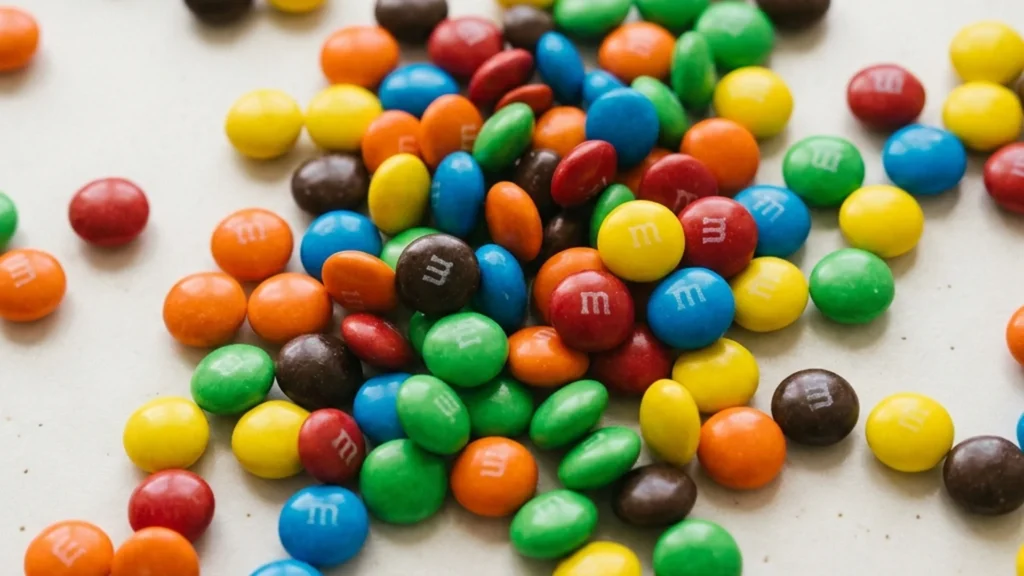
Are M&Ms gluten free? Most of the classic varieties are gluten free by ingredient, but a few are definitely not, and Mars does not label or certify any M&Ms as gluten free at all. That combination trips people up constantly. The plain Milk Chocolate and Peanut bags you grab at the checkout carry no gluten ingredients, while Pretzel and Crispy M&Ms contain wheat and barley outright. I keep a mental list of the safe ones, because the bag will never wave a gluten-free flag to help you.
Here is the quick answer you can rely on: Milk Chocolate, Peanut, Peanut Butter, and Almond M&Ms have no gluten ingredients and do not carry wheat warnings in the US, making them the safest picks. Pretzel M&Ms (wheat flour) and Crispy M&Ms (barley malt) are never safe. Because Mars makes M&Ms in shared facilities and does not certify them, the strictest celiacs should treat even the safe varieties as a small calculated risk and always re-read the bag.
The Short List: What Is Safe and What Is Not
The cleanest way to handle M&Ms is to memorize the two categories. Some varieties have a gluten-containing grain right in the ingredient list, full stop. Others are clean by ingredient. Here is the breakdown for the US market.
| M&M variety (US) | Status | Why |
|---|---|---|
| Milk Chocolate | Safe by ingredient | No gluten grains, no wheat warning |
| Peanut | Safe by ingredient | No gluten grains, no wheat warning |
| Peanut Butter | Safe by ingredient | No gluten grains listed |
| Almond | Safe by ingredient | No gluten grains listed |
| Caramel | Check the bag | Usually clean, verify current label |
| Pretzel | Not safe | Contains wheat flour |
| Crispy | Not safe | Contains barley malt |
| Sugar Cookie / seasonal | Check the bag | Limited editions vary, often risky |
The two to burn into memory are Pretzel and Crispy. Pretzel is obvious once you think about it, since a pretzel is wheat. Crispy is the sneaky one, because the crunch comes from a barley-malt crisp center, and barley contains gluten even though there is no wheat on the label. Crispy M&Ms are exactly the kind of product that tests positive for gluten while looking innocent.
Why Mars Will Not Just Say Gluten Free
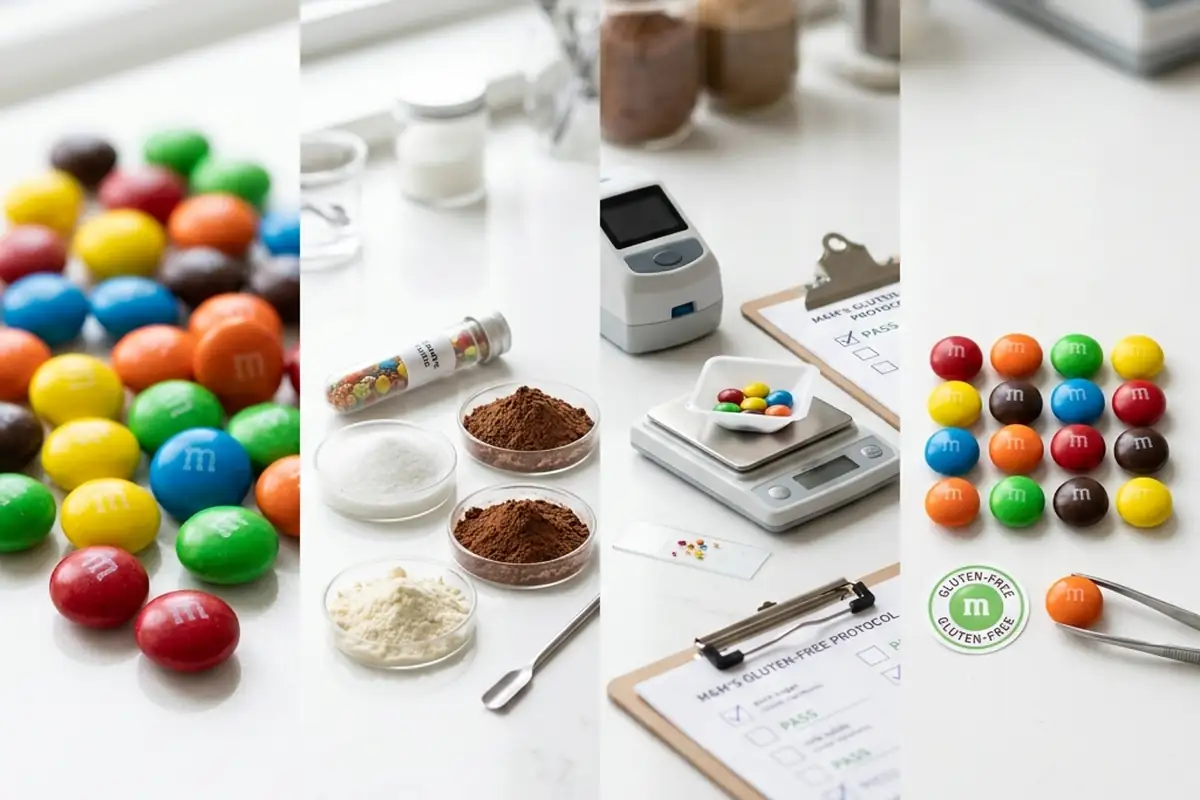
Here is the part that frustrates a lot of celiac shoppers. Mars Wrigley does not market any M&Ms as gluten free and does not pursue gluten-free certification for them. That is not because the safe varieties secretly contain gluten. It is because Mars makes M&Ms in facilities that also handle wheat and barley products, and the company will not put a gluten-free claim on a product made on shared lines without the testing and segregation that claim legally requires.
So what does “no certification” actually mean for you? For someone with a mild sensitivity, the safe varieties by ingredient are almost certainly fine, because the chance of meaningful cross-contamination in a sealed bag of plain M&Ms is low. For someone with diagnosed celiac disease, the absence of a certified seal means you are accepting a small unquantified risk. Many celiacs eat plain and Peanut M&Ms without trouble. Some choose certified candies instead. Both are reasonable calls, and you should make yours knowing the facility is shared and the testing is not published.
It helps to understand the standard a certified product would have to meet. In the United States, a gluten-free label legally requires a product to test below 20 parts per million of gluten, and many third-party certifiers hold to a stricter 10 ppm. Mars publishes no such number for M&Ms. That is the whole gap: a certified candy hands you a tested threshold, while an uncertified M&M hands you a clean ingredient list and nothing more. Neither is wrong, but a celiac should know which one they are getting. Over a year of regular snacking, those small risks add up differently for someone whose gut is damaged by trace amounts than for someone with a milder sensitivity.
The International Trap: US M&Ms Are Not Australian M&Ms
This is the detail that almost every US-focused article skips, and it has burned travelers. M&M formulas differ by country. A variety that is safe in the United States can contain gluten in another market under the same name and packaging colors.
The clearest example is Australia, where M&Ms have listed “starch (sources include wheat)” on varieties that are wheat-free in the US. Same brand, same look, different recipe. The lesson is blunt: do not assume your home-country knowledge travels with you. If you are buying M&Ms abroad, read that country’s label as if it were a brand you have never seen, because as far as gluten goes, it is. UK and European formulations can also differ, so the same scrutiny applies anywhere outside the US.
The reason behind this comes down to local sourcing and labeling laws. Manufacturers in different regions use different ingredient suppliers, and some countries permit wheat-derived starch or glucose syrup where US recipes use corn-based versions. Labeling rules also differ, so a “may contain” advisory that appears in one country may be absent in another even when the contamination risk is similar. For a traveler with celiac disease, the safe habit is to photograph the ingredient panel, and if the local language is a barrier, use a translation app to scan for the words meaning wheat, barley, and malt before eating a single piece.
How to Read an M&M Bag in Ten Seconds
Since the bag will not announce gluten-free status, you have to extract the answer yourself. Go straight to the allergen line first, the bold “Contains” statement under the ingredients. If it says “Contains: wheat,” you are done, put it back. Then scan the ingredient list for two grains: wheat and barley. Barley usually appears as “barley malt” or “malt,” and that is the word that flags Crispy and some seasonal varieties.
If neither grain appears and there is no “may contain wheat” advisory, the variety is safe by ingredient. If you see a “may contain wheat” precautionary warning even without wheat in the ingredients, treat that as a yellow light: probably low risk, but for celiac-level caution, skip it. Precautionary warnings are voluntary and inconsistent, so their presence tells you the company itself is not confident about cross-contact.
Halloween and the Shared Candy Bowl
If you have a celiac kid, the candy season is its own challenge, and plain M&Ms are usually one of the wins. The fun-size and snack-size Milk Chocolate and Peanut bags carry the same safe ingredients as the big bags, so trick-or-treat M&Ms are generally fine to keep.
The protocol I would use: sort the haul before anyone eats anything. Pull out the sealed, single-variety bags you can verify (plain and Peanut M&Ms qualify). Set aside anything unlabeled, homemade, or in a shared open bowl, because a scoop that touched pretzels or cookies is a cross-contact risk even if the candy itself is clean. Loose candy from a communal bowl is the real hazard, not the sealed fun-size bag. And keep Pretzel and Crispy M&Ms out of the safe pile entirely, since their festive packaging looks nearly identical to the plain ones. A quick sort up front beats a stomachache at midnight.
A trick that works well for younger kids is the candy swap. Let them sort their own haul into a safe pile and an unsure pile, then trade the unsure pile for a few items you have pre-vetted, a small toy, or a couple of dollars. It keeps the night fun, removes the temptation to grab a questionable piece, and teaches the label-reading habit early. I would also keep a backup stash of verified-safe plain M&Ms at home, so a celiac kid is never the only one without chocolate while everyone else digs in. The goal is a normal holiday, not a lecture, and a little preparation buys exactly that.
What to Do If M&Ms Made You Sick
If you ate M&Ms and reacted, work the problem instead of swearing off the brand. First, identify the exact variety. A reaction to Crispy or Pretzel is not a mystery, since both contain gluten grains outright, and the fix is simply never eating those two again. A reaction to plain or Peanut M&Ms is less obvious and worth tracing carefully.
Consider cross-contamination first. Did the M&Ms come from a shared bowl, a bulk bin, or a baking project where they touched flour? Loose candy is a far more likely culprit than a sealed bag. Next, check whether the candy was bought abroad, where the recipe may differ. And remember that not every stomach upset after candy is gluten: a large serving of chocolate, the sugar, or dairy in milk chocolate can all cause symptoms that mimic a gluten reaction. If sealed, US, plain M&Ms reliably make you sick, that points either to a real cross-contamination sensitivity on the shared line or to something other than gluten, and that is a conversation worth having with a dietitian rather than guessing alone.
What Counts as a Gluten Ingredient in Candy
M&Ms sit inside a bigger candy-label puzzle, and the same terms come up across brands. Wheat flour and wheat starch are obvious. Barley malt, malt syrup, and malt flavoring are barley-derived and contain gluten, and they hide in crisped and some chocolate-coated candies. Anything described as a “crisp,” “wafer,” “biscuit,” or “cookie” center is a strong candidate for wheat. Plain chocolate, sugar, cocoa butter, milk, peanuts, almonds, and the color additives that make M&Ms colorful are all gluten free.
That is why plain and nut M&Ms clear the bar so easily: their ingredient list is chocolate, sugar, a hard candy shell, and a nut or nothing. Add a grain-based crunch or coating and the answer flips. Once you can spot the grain-based add-ins, you can read almost any candy bag the same way you read M&Ms.
One ingredient that confuses people is “dextrose” or “glucose syrup.” In the US these are almost always corn-derived and gluten free, so they are not a reason to reject a candy. The same goes for the colorings and titanium dioxide that give M&Ms their shells. None of those carry gluten. Keeping a short mental list of the safe-sounding-but-actually-fine ingredients is just as useful as knowing the dangerous ones, because it stops you from needlessly avoiding candy that is perfectly safe.
Making Your Own Gluten-Free M&M Style Treats
When I want the M&M experience with zero label anxiety, I make a candy-coated snack mix at home, and it is easier than it sounds. Start with a base you fully control: certified gluten-free pretzels (yes, they exist, made from corn or rice), plain certified chocolate chips, and roasted peanuts. Melt 1 cup of chocolate chips gently, either in 30-second microwave bursts stirred between each, or in a heatproof bowl over barely simmering water at around 110 to 115 degrees F so the chocolate never scorches.
Toss 2 cups of your mix-ins in the melted chocolate, spread on a parchment-lined sheet, and let it set at room temperature for about 30 minutes or in the fridge for 10. Break it into clusters. You get the chocolate-and-crunch hit M&Ms deliver, with the certainty that every ingredient passed your own check. For a color-coated look, candy melts labeled gluten free work, though they trade some flavor for the shell. The point is that the M&M craving is solvable without rolling the dice on a shared facility.
If you bake, plain M&Ms (the safe varieties) also fold straight into gluten-free cookie dough. A standard batch takes about 1 cup of M&Ms folded into the dough, baked at 350 degrees F for 10 to 12 minutes. Using the verified-safe plain or Peanut varieties keeps the whole cookie clean, as long as your flour blend and other ingredients are gluten free too.
M&Ms in a Broader Gluten-Free Candy Strategy
M&Ms are a useful anchor for gluten-free snacking because the safe varieties are everywhere and cheap, but the same per-variety, per-label vigilance applies across the candy and snack aisle. The pattern of a brand having some safe products and some that hide a grain repeats constantly, exactly like the flavor-by-flavor reality behind whether Doritos are gluten free, where the chip is corn but the seasoning decides each flavor. The same per-product caution helps with chewy candies too, where gelatin and coatings raise their own questions, much like the considerations in the guide to dedicated gluten-free bakeries and why a controlled facility matters so much.
For broader gluten-free shopping guidance and ingredient deep-dives, America’s Test Kitchen publishes careful work on gluten-free baking and ingredients at America’s Test Kitchen, and Bon Appetit covers candy and dessert technique at Bon Appetit if you want to make your own gluten-free treats instead of decoding every label.
Frequently Asked Questions
Are plain M&Ms gluten free?
Plain Milk Chocolate M&Ms have no gluten ingredients and carry no wheat warning in the US, so they are safe by ingredient. They are not certified gluten free, because Mars makes them in shared facilities, so the strictest celiacs accept a small cross-contamination risk.
Are Peanut M&Ms gluten free?
Yes, Peanut M&Ms contain no gluten grains and do not carry a wheat warning in the US. They are one of the safer M&M choices by ingredient. As with all M&Ms, they are not certified gluten free, so verify the current label if you have celiac disease.
Which M&Ms are not gluten free?
Pretzel M&Ms contain wheat flour and Crispy M&Ms contain barley malt, so both are unsafe for anyone avoiding gluten. Sugar cookie and some seasonal limited-edition varieties can also contain gluten, so always check the bag on novelty flavors.
Why are M&Ms not labeled gluten free?
Mars does not certify M&Ms as gluten free because they are produced in facilities that also handle wheat and barley. A gluten-free claim requires testing and segregation Mars does not apply to these lines, so the company stays silent rather than risk an inaccurate claim.
Are M&Ms gluten free in other countries?
Not necessarily. Formulas vary by country. Australian M&Ms have listed wheat-derived starch on varieties that are wheat-free in the US. If you buy M&Ms outside the United States, read that country’s label as though it were an unfamiliar product.
Can celiacs eat M&Ms?
Many celiacs eat plain and Peanut M&Ms safely, since they have no gluten ingredients. Because the facility is shared and the product is not certified, it is a personal risk call. Avoid Pretzel and Crispy entirely, and choose certified candy if you want zero cross-contamination risk.
Bottom Line
M&Ms are mostly gluten free where it counts, with plain Milk Chocolate, Peanut, Peanut Butter, and Almond carrying no gluten ingredients in the US. The hard nos are Pretzel, which is wheat, and Crispy, which is barley malt, plus a rotating cast of seasonal flavors you have to check one by one. The wrinkle is that Mars never certifies these candies, so celiacs are weighing a small shared-facility risk rather than reading a clean gluten-free seal. Memorize the safe four, avoid the two grain-based ones, read the bag abroad, and sort the Halloween haul before anyone digs in. Do that and M&Ms stay one of the simplest treats to keep in a gluten-free house.