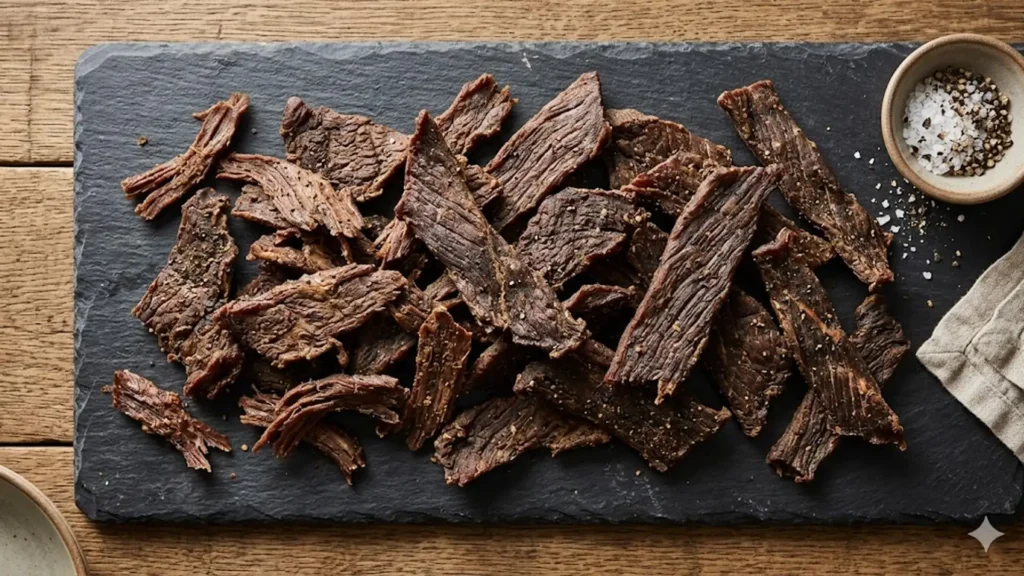
Is beef jerky gluten free? Plain beef jerky, made from just meat and salt, is naturally gluten free. The problem is that almost no jerky is just meat and salt. The marinade is where gluten hides, and the single biggest culprit is soy sauce, which is brewed with wheat. Teriyaki, hickory, and “original” flavors often carry it, along with worcestershire sauce and the occasional hydrolyzed wheat protein. So the honest answer is: beef itself has zero gluten, but you have to read the bag, because the flavoring decides.
I keep jerky in my bag for road trips and hikes, and I have learned to read these labels at a glance. Most people get tripped up by one or two ingredients that sound scary but are fine, and miss the two or three that actually matter. Let me give you the short list of real offenders, a label decision tree, the brands that test clean, and a homemade method with exact temperatures so you never have to wonder again.
Why Plain Jerky Is Gluten Free and Flavored Jerky Often Is Not
Beef is a single-ingredient protein. There is no gluten in a cut of meat, full stop. Gluten is a wheat, barley, and rye protein, and cows are none of those. If you dehydrate beef with nothing but salt, you have gluten free jerky. The trouble starts the moment a marinade enters, because jerky lives and dies on flavor, and the cheapest, most common flavor base is soy sauce.
Standard soy sauce is fermented with wheat. A teriyaki jerky almost certainly used it. So did many “original” and “hickory” recipes, because soy sauce is the backbone of that savory, salty taste. The fix on the manufacturing side is simple, swap soy sauce for tamari, the gluten free cousin, and plenty of brands now do exactly that. Your job is to figure out which ones.
The Hidden-Ingredient Glossary
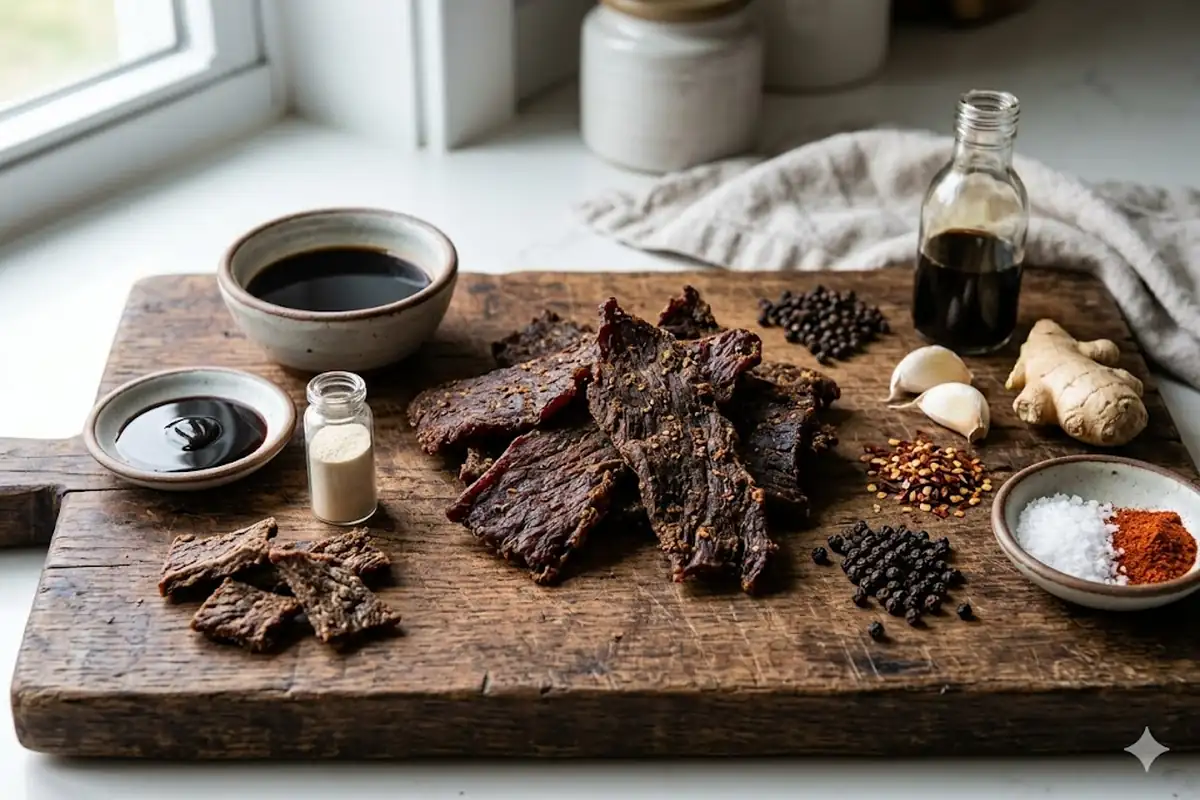
Here is the list I scan for. Memorize the top three and you will catch almost every gluten trap in the jerky aisle.
- Soy sauce – the number one source. Contains wheat unless it specifies gluten free or tamari.
- Worcestershire sauce – traditional versions contain malt vinegar from barley. A real offender.
- Hydrolyzed wheat protein – exactly what it sounds like. Wheat. Avoid.
- Malt, malt extract, malt flavoring – barley-derived. Common in smoky flavors.
- Barley, rye – rare in jerky but possible in specialty marinades.
- Natural flavors – usually fine, but a vague catch-all. When the bag is not labeled gluten free and this is the only questionable line, contact the brand or skip it.
The Ingredients That Sound Scary But Are Fine
This trips people up constantly. Maltodextrin is gluten free in the United States, even though it has “malt” in the name, because it is almost always made from corn. Modified food starch in U.S. products is corn or potato unless it says wheat. And caramel color is gluten free here. The first time I saw maltodextrin on a jerky bag I almost put it back, then realized I was reacting to the word, not the ingredient. Do not let the false alarms cost you a good bag.
The Beef Jerky Gluten Decision Tree
Run this in the aisle. It takes ten seconds.
- Is the bag labeled “gluten free”? Buy it. That claim is regulated to under 20 parts per million.
- No label, but a short ingredient list (beef, salt, spices)? Almost certainly safe. Scan for soy sauce and worcestershire to confirm.
- Is it teriyaki, hickory, or sweet-and-savory flavored? Read every line. These lean on soy sauce. Look for tamari or a gluten free note.
- Is it from a gas station counter or a bulk bin? Treat as unknown. No ingredient panel means no way to verify.
- Restaurant or homemade by someone else? Ask what is in the marinade. Soy sauce is the default answer, so confirm.
No other guide for this question lays the decision out as a flow. It is the fastest way to a confident buy, and it works for any flavor in any store.
Gluten Free Beef Jerky Brands That Test Clean
Plenty of brands now make gluten free jerky, and several go further with dedicated facilities to control cross contamination, which matters for celiacs sensitive to trace amounts.
| Brand | Gluten free? | Note |
|---|---|---|
| Epic Provisions | Yes | Clean labels, often soy free too |
| Chomps | Yes | Certified, widely stocked sticks |
| The New Primal | Yes | Uses gluten free seasonings |
| Stryve | Yes | Biltong style, no soy sauce |
| People’s Choice | GF line | Separate gluten free processing |
| Paleo Valley | Yes | Grass-fed, soy free, clean |
When a brand carries a gluten free certification or runs a dedicated line, an outside check has confirmed the under-20-ppm threshold. That is the safest tier for celiac disease. Always confirm on the current bag, since recipes change.
Gluten Free Versus Soy Free: Not the Same Thing
This distinction matters and most lists blur it. A jerky can be gluten free and still contain soy, because the brand swapped wheat-based soy sauce for tamari or coconut aminos. Tamari is usually made from soybeans with little or no wheat, so it is gluten free but not soy free. Coconut aminos, on the other hand, is both gluten free and soy free, which is why brands chasing the allergy-friendly crowd reach for it. If you only need gluten free, tamari-based jerky is fine. If you also avoid soy, look for coconut aminos on the label or a brand like Stryve that skips the soy base entirely.
For more on how this soy sauce trap shows up across the pantry, recipesbend breaks it down in the guide to fish sauce and gluten, which shares the same brewed-condiment problem. And if you snack on jerky alongside chips, the flavor-by-flavor look at Doritos is a useful companion, since seasoned snacks hide gluten the same way flavored jerky does.
Cross-Contamination: The Risk Beyond the Ingredient List
Even when the ingredient list is clean, there is a second layer celiacs need to think about: shared equipment. A facility that runs both teriyaki (soy sauce) and a plain flavor on the same line can transfer trace gluten to the plain bag. This is why a “no gluten ingredients” jerky is not the same as a “certified gluten free” jerky. The first means no gluten was added on purpose. The second means an outside lab confirmed the finished product stays under 20 parts per million, which accounts for cross contamination too.
For most people with a mild sensitivity, a clean ingredient list is plenty. For celiac disease, especially if you react to trace amounts, the certified bag or the dedicated-facility brand is worth seeking out. People’s Choice running a separate gluten free process is a good example of a company taking that extra step. It costs a little more, and for a sensitive gut it removes the guesswork.
What Most Jerky Guides Get Wrong
Two patterns show up in nearly every article on this topic, and both leave the reader short. The first is the brand-owned post that answers the question just enough to sell you their jerky, skipping the false-alarm ingredients and the homemade route entirely. The second is the listicle that dumps 17 brand names with no explanation of why they qualify or how to verify a bag the list does not cover.
Neither teaches you to read a label on your own, which is the only skill that actually protects you in a store the list never mentioned. That is the gap this guide fills: the three ingredients that matter, the three false alarms that do not, a decision tree for any bag, and a homemade method for when you want zero doubt. My honest take after years of buying jerky on the road: learn the six-word scan (soy sauce, worcestershire, hydrolyzed wheat), and you will never again need someone else’s brand list to feel safe in the aisle.
How to Make Gluten Free Beef Jerky at Home
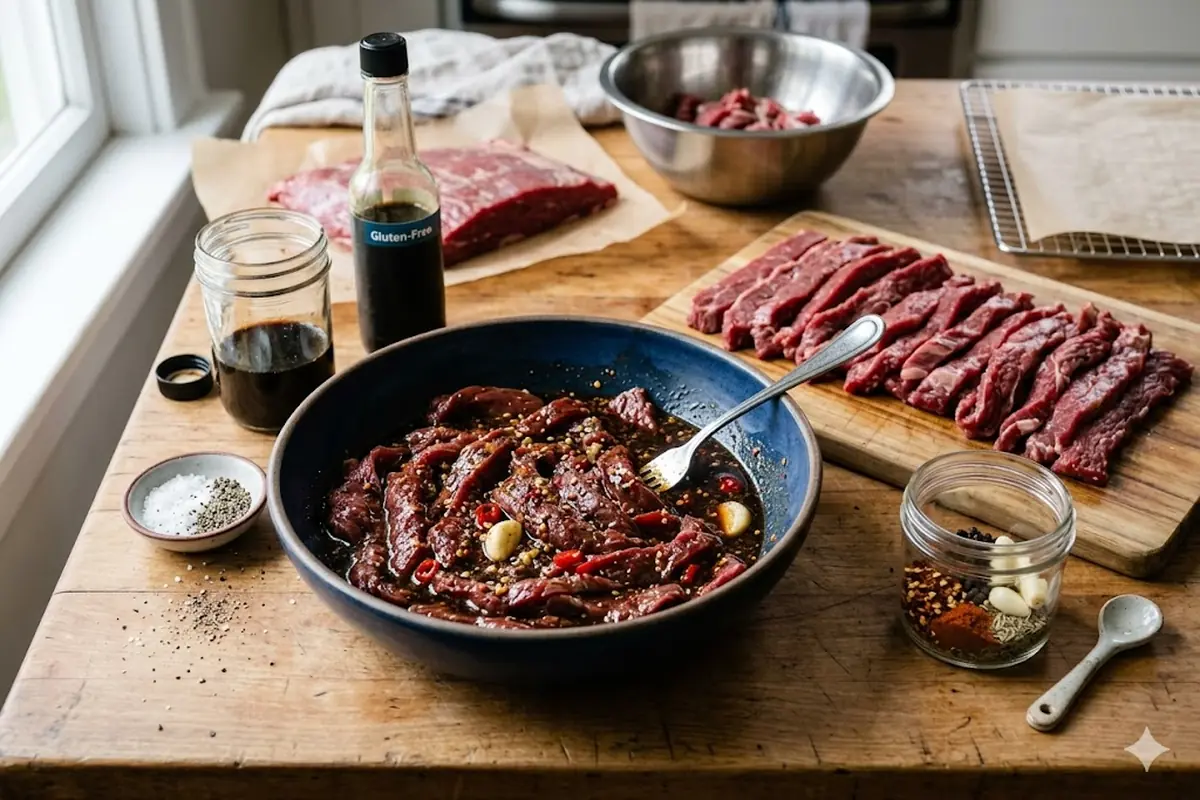
Making your own is the surest way to know exactly what is in it, and it is easier than people think. Here is the method I use.
Start with a lean cut, top round or eye of round, trimmed of fat (fat goes rancid and ruins shelf life). Slice it thin against the grain for tender jerky or with the grain for chewy, about one-eighth inch. For the marinade, use gluten free tamari or coconut aminos in place of soy sauce, plus garlic powder, onion powder, black pepper, and a touch of honey or maple. Marinate 6 to 24 hours in the fridge.
Dry it at 160 to 165 degrees F in a dehydrator for 4 to 6 hours, or in an oven set to 175 degrees F with the door cracked, checking at the 3-hour mark. Jerky is done when it bends and cracks but does not snap. That temperature matters: the U.S. Department of Agriculture recommends heating jerky to 160 degrees F to kill bacteria, so do not dry it cooler than that for safety. The whole process is hands-off once the marinade is mixed, and you end up with jerky that is guaranteed gluten free because you chose every ingredient.
A couple of details make or break a batch. Trim every visible scrap of fat, because fat does not dehydrate and it turns rancid, cutting your shelf life from weeks to days. Freeze the beef for about 30 minutes before slicing; firm meat cuts into clean, even strips that dry at the same rate. And do not crowd the dehydrator trays, since the strips need airflow on all sides to dry evenly. Get those three right and your homemade gluten free jerky rivals anything in a bag, at a lower cost per ounce.
If you want to round out a homemade snack spread, the team at bbq sauces on saucegrove has dips that pair well, just confirm the recipe uses gluten free worcestershire.
Biltong, Carne Seca, and Other Jerky Cousins
Jerky has relatives, and their gluten status varies. Biltong, the South African air-dried beef, is traditionally cured with vinegar, salt, and spices, often with no soy sauce at all, which makes brands like Stryve naturally gluten free. Carne seca, the Mexican dried beef, is usually just beef, salt, lime, and chili, so it tends to be gluten free too, though restaurant versions can pick up gluten from a shared marinade or seasoning blend. Pemmican, the traditional dried-meat-and-fat preparation, is gluten free in its classic form. The takeaway is the same across all of them: the meat is never the problem, the seasoning is, so the question you ask does not change.
One more cousin worth flagging is the meat stick, the Slim Jim style snack. Those are a different animal. Many contain wheat-based fillers or are made on lines with gluten, so do not assume a meat stick follows the same rules as a clean piece of jerky. Read it the same way you read everything else.
Storing and Traveling With Gluten Free Jerky
Once you have safe jerky, keep it that way. Commercial jerky is shelf-stable until opened, then best within a week or two at room temperature, or a month in the fridge. Homemade jerky has no preservatives, so refrigerate it and eat within one to two weeks, or freeze it for up to 6 months. For travel, the sealed single-serve bags are your friend, both for freshness and because the intact label travels with you, so you can prove it is gluten free if anyone asks at a shared snack table. I always pack the labeled bags rather than loose jerky in a container, exactly so the proof goes where the snack goes.
Reading a Jerky Label in Five Seconds
Flip the bag and run the check. One, look for a “gluten free” claim on the front. Two, scan the ingredients for soy sauce, worcestershire, hydrolyzed wheat protein, and malt. Three, ignore the false alarms: maltodextrin, modified food starch, and caramel color are fine in U.S. products. Four, read the allergen line, which must declare wheat by law. Five, when a flavored jerky has no gluten free claim and lists soy sauce, put it back. America’s Test Kitchen has tested jerky technique if you want to refine your homemade batch, and their work lives at America’s Test Kitchen. Bon Appetit also publishes reliable jerky and marinade guidance at Bon Appetit.
FAQ
Is all beef jerky gluten free?
No. Plain beef jerky made from meat and salt is naturally gluten free, but most flavored jerky uses soy sauce, worcestershire, or other marinades that contain gluten. Always read the label and look for a gluten free claim or a tamari-based recipe.
What makes beef jerky not gluten free?
The marinade. Soy sauce is the most common gluten source, since it is brewed with wheat. Worcestershire sauce (barley malt) and hydrolyzed wheat protein are the other two main offenders. Teriyaki and many original flavors rely on soy sauce.
Is teriyaki beef jerky gluten free?
Usually not. Teriyaki is built on soy sauce, which contains wheat. Some brands make a gluten free teriyaki using tamari, but assume teriyaki jerky has gluten unless the bag specifically says gluten free.
Is maltodextrin in jerky gluten free?
Yes, in the United States. Despite the name, maltodextrin is almost always made from corn and is gluten free. Do not skip a bag over maltodextrin. The ingredients that actually matter are soy sauce, worcestershire, and hydrolyzed wheat protein.
Which beef jerky brands are gluten free?
Epic Provisions, Chomps, The New Primal, Stryve, Paleo Valley, and People’s Choice (gluten free line) all offer gluten free jerky. Several also run soy free or dedicated facilities, which helps celiacs avoid cross contamination. Confirm on the current bag.
Can celiacs eat beef jerky?
Yes, as long as it is labeled gluten free or made with gluten free ingredients. For trace sensitivity, choose a brand with a gluten free certification or a dedicated processing line. Plain or tamari-based jerky is the safest pick.
Is gas station beef jerky gluten free?
It depends entirely on the brand and flavor. If it is a sealed bag with an ingredient panel and a gluten free claim, you can verify it. Bulk-bin or counter jerky with no label should be treated as unknown and skipped if you have celiac disease.
Bottom Line
Is beef jerky gluten free? The beef is, every time. The marinade is the question. Soy sauce, worcestershire, and hydrolyzed wheat protein are the three ingredients that turn a safe snack into a risky one, while maltodextrin and modified starch are harmless false alarms. Read the bag, lean on certified brands like Chomps or Epic, and if you want zero doubt, make your own with tamari at 160 degrees F. Do that and jerky stays what it should be: a high-protein, naturally gluten free snack you can throw in a bag and forget about until you need it on a long drive or a hard hike.