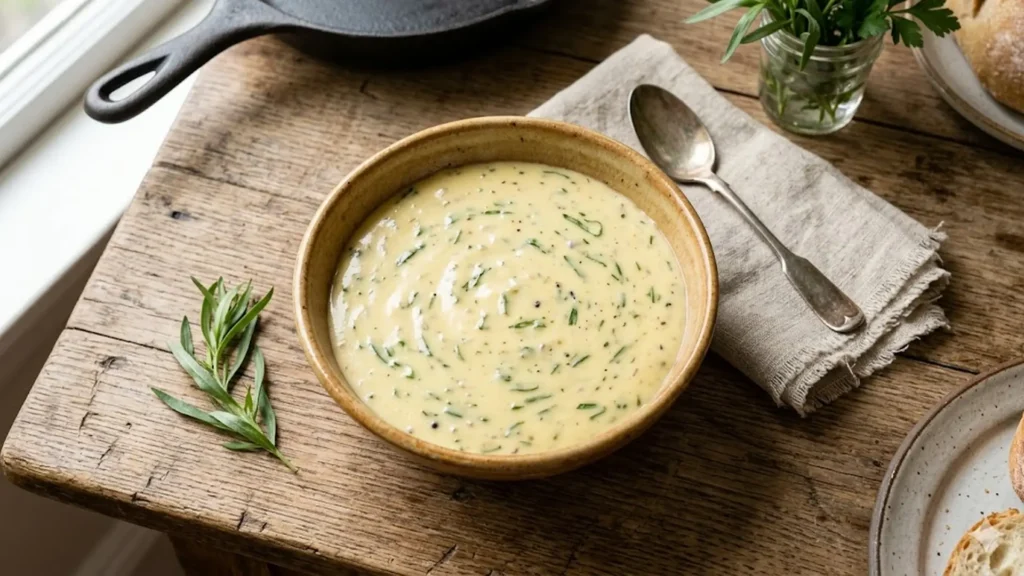
Is bearnaise sauce gluten free? Classic bearnaise made from scratch is naturally gluten free. The traditional sauce is just egg yolks, butter, white wine vinegar, shallots, and tarragon, none of which contain gluten. Unlike a gravy or a bechamel, bearnaise is thickened by emulsion, not by flour, so there is no roux to worry about. The catch is the shortcut versions: powdered packet mixes and some jarred sauces use wheat flour as a thickener, and that is where gluten sneaks in.
I make bearnaise a few times a year for steak night, and I have learned that the question is never about the sauce itself. It is about which version you are eating. A from-scratch bowl is safe. A Knorr packet usually is not. A restaurant sauce is a coin flip until you ask. Let me walk you through all three, plus a vinegar trap most guides skip, a store-brand table, and a foolproof blender method so you can just make your own.
Why Real Bearnaise Is Naturally Gluten Free
Bearnaise belongs to the French mother-sauce family as a child of hollandaise. Both are emulsified butter sauces, meaning they get their silky thickness from egg yolks binding with fat, not from starch. That is the whole reason this sauce is naturally gluten free. There is no flour, no roux, no wheat thickener anywhere in the classic recipe.
Run down the ingredient list: egg yolks, unsalted butter, white wine vinegar, dry white wine, shallots, fresh tarragon, salt, and pepper. Every one of those is gluten free. The vinegar reduction gives bearnaise its tang and its signature tarragon flavor, and it is what separates bearnaise from plain hollandaise. Nothing in that process introduces gluten. If you make it at home with those ingredients, you have a gluten free sauce, full stop.
It helps to compare bearnaise to a sauce that is not gluten free, so the difference is concrete. A classic gravy or a sausage gravy starts with a roux: flour cooked in fat, then thinned with liquid. That flour is wheat, which is why standard gravy is off limits on a gluten free diet unless it uses a cornstarch or rice-flour swap. Bearnaise never touches flour. It gets its body from the way egg yolks trap tiny droplets of butter in suspension, the same physics that makes mayonnaise thick. No starch, no roux, no gluten. Once you see that the thickening mechanism itself is flour-free, the answer to the question stops being a guess and becomes a rule.
The One Ingredient to Double-Check
Vinegar. White wine vinegar, the standard for bearnaise, is gluten free. So is apple cider vinegar and distilled white vinegar. The one to avoid is malt vinegar, which is made from barley and is not gluten free. No traditional bearnaise recipe calls for malt vinegar, but if you are improvising or using a pre-made reduction, glance at the bottle. It is a rare trap, but it is a real one, and it is the kind of detail that separates a careful kitchen from a glutened guest.
The Bearnaise Gluten Decision Tree
Here is the flow I run before I eat bearnaise anywhere.
- Made from scratch with real ingredients? Safe. Egg yolks, butter, wine vinegar, tarragon, shallots have no gluten.
- From a powdered packet mix? Assume gluten. Knorr and most powdered bearnaise use wheat flour to thicken. Read the box; if it is not labeled gluten free, skip it.
- From a jar or refrigerated tub? Read the label. Some use cornstarch (gluten free), some use wheat. It varies by brand.
- At a restaurant? Ask one question: is the bearnaise house-made or from a mix? House-made from scratch is almost always safe. A mix is a question mark.
- Improvised with an unknown vinegar? Confirm it is not malt vinegar.
No other guide on this question lays it out as a flow. It is the fastest path to a confident yes, and it covers every way you might encounter the sauce.
Store-Bought Bearnaise: The Brand Reality
This is the section the recipe blogs skip. If you are not making it yourself, the brand matters enormously.
| Type | Gluten status | Note |
|---|---|---|
| Knorr Bearnaise Sauce Mix | Contains gluten | Wheat flour is the thickener |
| Most powdered packet mixes | Usually contain gluten | Wheat flour or wheat starch base |
| Epicure-style mixes | Some gluten free | Use cornstarch instead of wheat |
| Jarred refrigerated bearnaise | Varies | Read the label every time |
The pattern is simple: powdered mixes lean on wheat flour because it is the cheapest thickener that survives drying. Gluten free mixes swap in cornstarch. When a label says gluten free, it has been verified to under 20 parts per million under U.S. Food and Drug Administration rules. When it does not, and it lists wheat flour, treat it as off limits.
Eating Bearnaise at a Restaurant
Bearnaise shows up on steakhouse menus draped over filet mignon, and on brunch menus near eggs benedict. The good news is that a kitchen serious enough to offer bearnaise usually makes it from scratch, which means it is usually gluten free. The risk is the kitchen that uses a powdered mix to save labor. Ask your server one direct question: is the bearnaise made in-house or from a mix? House-made is your green light. If they are not sure, ask them to check, because the difference is wheat flour or no wheat flour. I have asked this at enough steakhouses that it no longer feels awkward; most servers know the answer or find out fast.
One more restaurant note: cross contamination is low risk for an emulsion sauce, since it is not fried or floured. The only real variable is the thickener. Nail that question and you have your answer. A small tell that a kitchen makes it from scratch is a slightly different color or texture from plate to plate, or visible flecks of fresh tarragon. A perfectly uniform, pale sauce can signal a reconstituted mix, though it is not proof on its own, so the question to your server is still the reliable move.
The Foolproof Gluten Free Bearnaise Method
Making bearnaise has a reputation for being fussy, but an immersion blender takes the fear out of it. Here is the method I rely on.
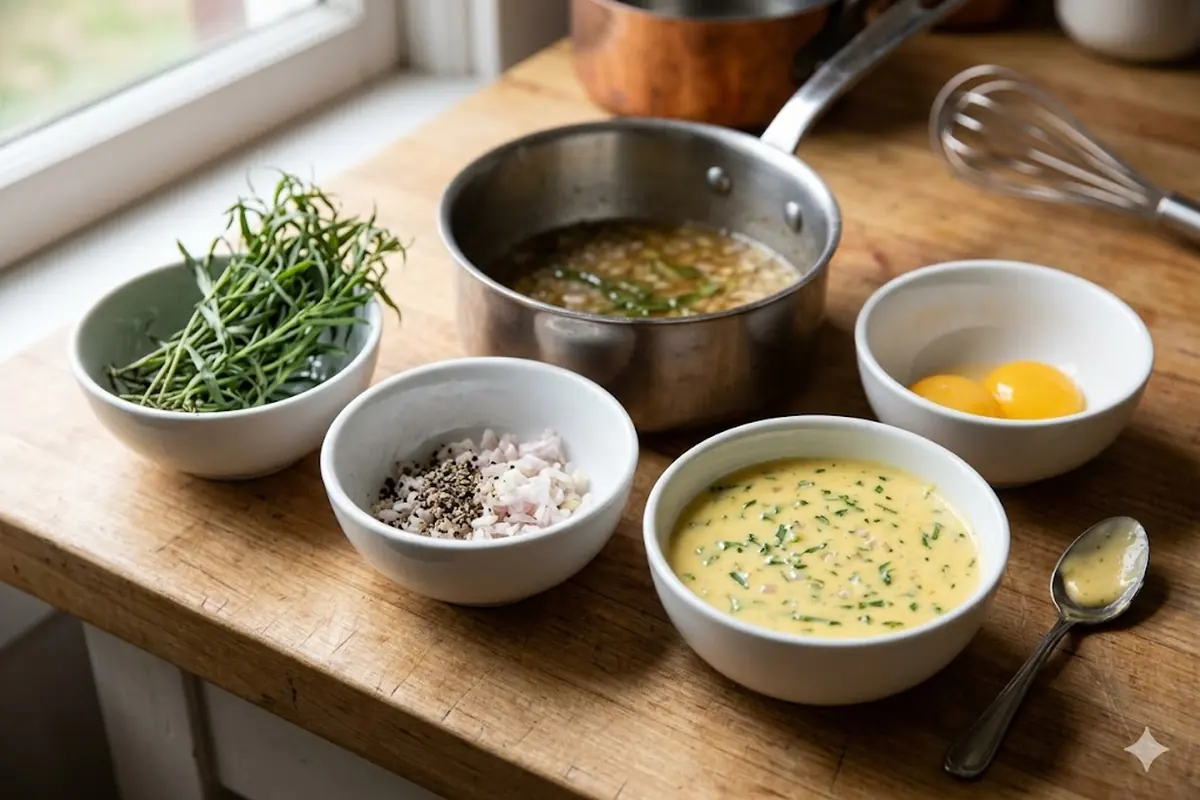
First, make the reduction. Simmer 2 thinly sliced shallots, half your tarragon, 40 ml (about 3 tablespoons) of white wine vinegar, and a splash of dry white wine for 4 to 5 minutes until reduced by half. Strain out the solids and let the liquid cool. This is the flavor base, and cooling it matters so it does not scramble the yolks.
Melt 200 grams (about 1.5 sticks) of unsalted butter until hot. Put 3 egg yolks and the cooled reduction in a tall jar or beaker. Lower the immersion blender to the bottom, turn it on, and slowly stream the hot butter in while blending. The sauce emulsifies and thickens as you go. Off the heat, fold in the rest of the chopped tarragon, season with salt and pepper, and serve right away. That is restaurant-quality gluten free bearnaise in about ten minutes of active work.
Rescuing a Broken Sauce
If the sauce splits and goes thin or greasy, do not toss it. The fix that has saved me every time: whisk a tablespoon of cold water, or a fresh egg yolk, into a clean bowl, then slowly whisk the broken sauce back in a little at a time. It re-emulsifies. Keeping the butter warm rather than scorching hot, and adding it slowly, prevents most breaks in the first place. Heat is the enemy of an emulsion, so go gentle.
Bearnaise Variations and Whether They Stay Gluten Free
Bearnaise has a small family of spinoffs, and the good news is they are all naturally gluten free for the same reason the original is. Sauce choron is bearnaise with tomato paste added, which gives it a rosy color and a subtle sweetness; tomato paste is gluten free, so choron is too. Sauce foyot, also called sauce valois, is bearnaise enriched with a spoon of meat glaze (glace de viande); as long as that glaze was made from reduced stock and not a wheat-thickened gravy base, it stays gluten free. Sauce paloise swaps the tarragon for mint, a straight herb substitution with no gluten impact and a fresh flavor that suits lamb beautifully.
The lesson across all of them is the same one that runs through this whole guide: the emulsion base is never the problem, so a variation only becomes risky if someone adds a wheat-thickened component. A spoon of real meat glaze is fine. A spoon of packet gravy mix is not. When you make these at home, you control that, which is the strongest argument for scratch over shortcut.
Can You Make Bearnaise Ahead of Time?
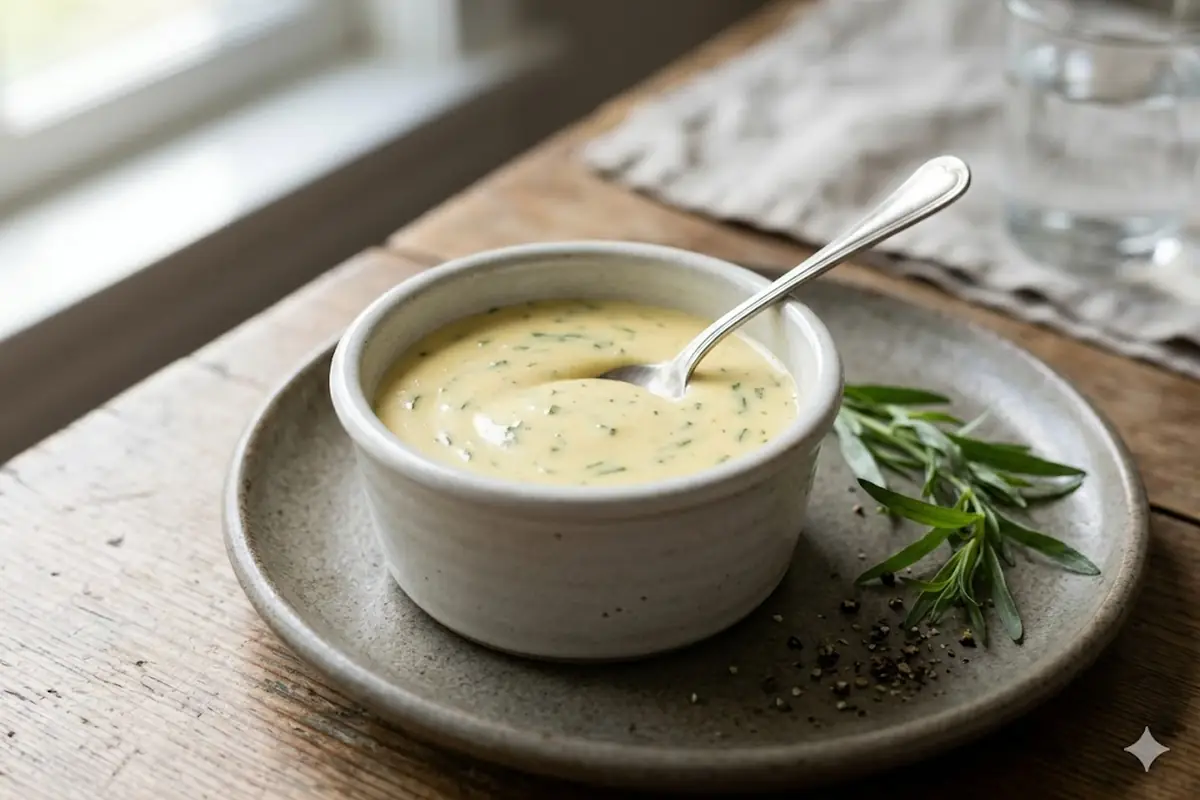
This comes up around holidays, when the stove is crowded and you want one less thing to finish at the last second. Bearnaise is an emulsion held together by warmth, so it does not love sitting. It will hold for about an hour if you keep it warm, not hot, in a bowl set over warm (not simmering) water, or in a thermos rinsed with hot water. Do not refrigerate and reheat it directly, because the emulsion breaks when it cools and the butter solidifies. If you must prep ahead, make the vinegar reduction earlier in the day and refrigerate just that part; it keeps for a couple of days. Then do the quick blender emulsion right before serving. That splits the work without risking the sauce, and it keeps everything gluten free since you are still using your own ingredients start to finish.
What to Serve It With
Bearnaise is built for steak, but it does not stop there. It is excellent on grilled salmon, halibut, and shrimp, on roasted asparagus and broccoli, over a baked potato, and on eggs benedict in place of plain hollandaise. Because it is naturally gluten free, it pairs cleanly with a gluten free meal without any swaps. If you are checking the rest of your plate, recipesbend has a useful look at whether butter is gluten free, which matters here since butter is the backbone of the sauce, and a guide to fish sauce and gluten if you are building a surf-and-turf spread with Asian flavors. For sauce ideas beyond bearnaise, the cream sauces collection on saucegrove is worth a browse, just confirm each recipe skips wheat-based thickeners.
How to Read a Bearnaise Label in Five Seconds
Flip the packet or jar and run the check. One, look for a “gluten free” claim on the front. Two, scan the ingredients for wheat flour, wheat starch, or modified wheat starch, the usual thickeners in mixes. Three, if it lists cornstarch or no thickener and carries a gluten free claim, you are good. Four, read the allergen line, which must declare wheat by law. Five, when a powdered mix has no gluten free claim and lists wheat, put it back and make it from scratch instead, since scratch bearnaise is both safer and better. America’s Test Kitchen has tested emulsion sauces extensively if you want to refine your technique, and their work lives at America’s Test Kitchen. Bon Appetit also publishes reliable bearnaise and hollandaise breakdowns at Bon Appetit.
What Other Bearnaise Guides Miss
Most pages on this question fall into one of two camps. The recipe blogs hand you a from-scratch recipe and call the question answered, never mentioning that the version you are most likely to buy, a Knorr packet, is the one that will get you. The quick-answer sites say “naturally gluten free, check labels” and stop, with no brand specifics and no vinegar warning.
Neither closes the loop. The reader standing in front of a powdered mix or sitting at a steakhouse still does not know what to do. That is the gap this guide fills: a decision tree for scratch versus packet versus restaurant, a brand table that names Knorr as a wheat-thickened mix, the malt-vinegar trap nobody flags, and a foolproof blender method for when you want zero doubt. My honest opinion after making this sauce for years: skip the packets entirely. Scratch bearnaise takes ten minutes with a blender, tastes far better, and removes the gluten question completely. The packet only exists to save a step that is not worth saving.
FAQ
Is bearnaise sauce gluten free?
Traditional bearnaise made from scratch is naturally gluten free, since it is thickened by an egg-and-butter emulsion rather than flour. The exceptions are powdered packet mixes and some jarred versions, which often use wheat flour as a thickener. Always check the label on store-bought bearnaise.
Does bearnaise sauce have flour in it?
Classic bearnaise has no flour. It thickens through emulsification of egg yolks and butter. Powdered mixes are the exception, since they commonly add wheat flour or wheat starch to thicken when reconstituted with liquid.
Is Knorr Bearnaise Sauce Mix gluten free?
No. Knorr Bearnaise Sauce Mix contains wheat flour as a thickener, so it is not gluten free. If you want the convenience of a mix, look for a specialty brand that uses cornstarch and carries a gluten free label.
Is restaurant bearnaise gluten free?
Usually, if it is house-made from scratch, which most quality kitchens do. The risk is a restaurant using a powdered mix. Ask your server whether the bearnaise is made in-house or from a mix before ordering.
Is bearnaise the same as hollandaise for gluten?
Yes, in terms of gluten. Both are emulsified butter sauces with no flour, so both are naturally gluten free when made from scratch. Bearnaise simply adds a tarragon-and-vinegar reduction that hollandaise does not have. The same packet-mix caution applies to both.
What vinegar is gluten free for bearnaise?
White wine vinegar, the traditional choice, is gluten free, as are apple cider vinegar and distilled white vinegar. Avoid malt vinegar, which is made from barley and contains gluten. No standard bearnaise recipe uses malt vinegar, but confirm if you are improvising.
Can I make gluten free bearnaise easily?
Yes. An immersion blender makes it nearly foolproof: blend egg yolks with a cooled wine-vinegar-tarragon reduction, then stream in hot melted butter while blending until thick. Using real ingredients guarantees it is gluten free, and it takes about ten minutes.
Bottom Line
Is bearnaise sauce gluten free? From scratch, yes, every time, because it thickens with egg and butter rather than flour. The gluten only enters through shortcuts: powdered mixes like Knorr that use wheat flour, the occasional jarred version, and the rare malt-vinegar improvisation. Read the label on anything pre-made, ask whether a restaurant version is house-made, and when in doubt, make your own. Ten minutes with an immersion blender gives you a gluten free bearnaise that beats any packet and ends the question for good. Keep white wine vinegar in the pantry, keep good butter in the fridge, and steak night is never a gluten gamble again.